Who Were You Before The World Told You Who To Be
Before expectations.
Before comparison.
Before learning which parts of you were “too much.”
Who were you?
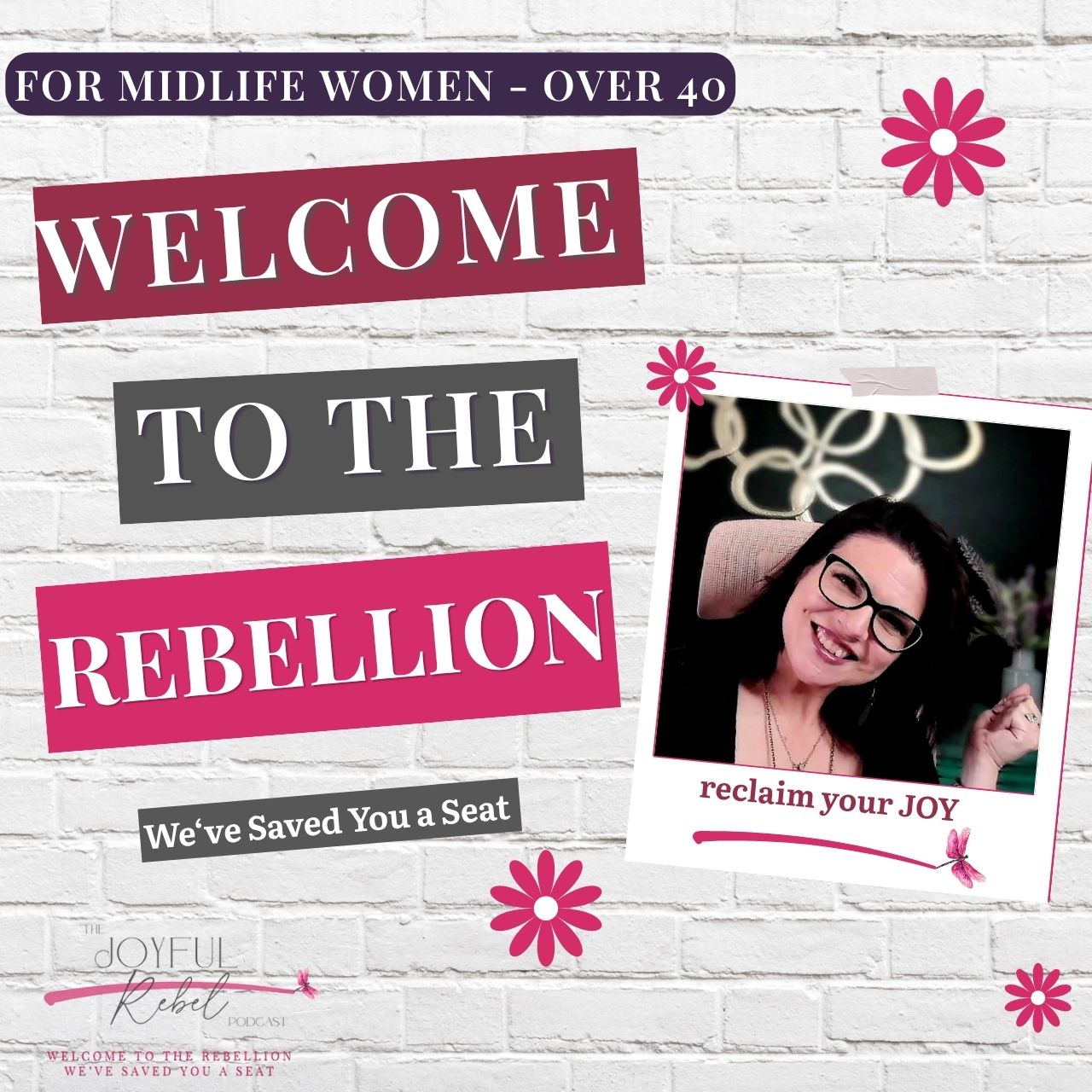
Hey friends, welcome back to the Joyful Rebel podcast.
If this is your first time here, I'm so glad you found your way in. If you are returning, thank you for coming back and continuing this journey with me.
If you didn't have a chance to listen to last week's episode, I highly encourage you to go back and check it out. It's where I shared the Joyful Rebel Manifesto, the vision that has anchored my life and my work over the last year.
Today, though, we're starting where all identity work really begins—
Not with who you should be. Not with who you became out of necessity. But with a quieter and braver question. Who were you before the world told you who to be?
Because before expectations, before comparison, before learning what was too much or not enough or not practical, there was a version of you that moved through the world with curiosity and imagination and instinct. And that version of you didn't disappear.
She went quiet.
When I sit with this question, my mind almost automatically goes back to my childhood, not in a rose colored, everything was perfect kind of way. Although yes, some memories are definitely fuzzy edged and glitter dusted, but more in a pattern noticing way.
When I look honestly at little Rachel, what I see are the things that lit me up. What I found beautiful or interesting. How I made meaning out of the world, and the moments where I felt most like myself.
This was before I learned the parts that were too sensitive or too much.
It was before playground rules or social dynamics or small wounds started shaping how I showed up to the world.
And here's the thing I want you to hear: Your earliest joys, they're not random. They are clues.
The ReStory Arc™ and The Wonder Window
In my work, I use a story framework called the ReStory Arc™ because we don't actually live in bullet points, right? We live in stories, and every story begins in what I call the Wonder Window.
This is actually one of my favorite parts to decide for all of my main characters in all of the books I wrote. It's the part of the story where curiosity is alive. Imagination leads. It's where, if you're young, identity hasn't learned to perform yet, or later in life, those moments where the more innocent, hopeful version of you peeks back out again.
It's where joy sparks unexpectedly, where delight sneaks in. Where play shows up without asking permission.
Think Anne of Green Gables naming everything beautiful.
Lucy stepping into Narnia through the wardrobe without demanding proof or even pausing to question, How is this possible?
It's Elizabeth Bennett noticing what others missed, and it's Lorelai Gilmore trusting her instincts long before life complicated them.
Wonder is, in many ways, pre-performance.
And even as adults, wonder still enters the story whenever we drop the mask, intentionally or not.
Christmas mornings. Disney World with the kids. A memory that suddenly lights up your body again. That flutter? That warmth? That's information.
This is one reason why Pride and Prejudice and Little Women are still so loved and so relatable.
It's not because of romance or nostalgia—or I should say, it's not the only reason. 😉
It's because of identity. We recognize ourselves in characters who start with clarity, lose it under pressure, and then slowly reclaim it.
Elizabeth Bennett doesn't change who she is. She remembers it.
Jo March doesn't become bold. She stops apologizing for being bold.
That's identity work.
The Shift
Here's what usually happens next in real life.
The world introduces conditions.
Be kind, but don't be inconvenient.
Be creative, but make it useful.
Be faithful, but don't ask too many questions.
Be joyful, but not too loud about it.
So we adapt. We trade instinct for approval, wonder for self-protection and curiosity for caution.
Not because we're weak, but because we're relational.
When I look over my own story, I can see the exact moments where things like this happened. Moments where I realized:
Oh, this part of me doesn't land well here.
Or This part does not fit in here.
Or maybe, Okay, that question makes people uncomfortable. Noted.
So, I learned to manage myself. I don't think it was even conscious at first. But over time, it became automatic.
Whenever I entered situations that I'd already decided needed a different version of me, from one footfall to the next, I would slip into rolls or slide on masks.
Almost without thinking about it, I dimmed my light. Pretended I agreed—when I didn't. Or that I didn't have an opinion—when I did.
I turned certain qualities up 10x, even when I wasn't really feeling it.
And all of that image management worked. It worked for the people I was around, which is why I kept doing it, of course. And because it worked for them, a part of me believed that it worked for me too.
I got validation, belonging, less friction. It worked...Until it didn't.
This is why the Wonder Window matters. It isn't just a storytelling device.
This is a real talk, real life, lived experience that shows up time and again throughout our lives. And just like everything else that comes to this kind of work, when we start to notice these things, it's powerful.
Wonder is where identity begins. Shrinking is where it gets complicated.
Fun Homework!
Here's a place to start noticing. No fixing, no forcing, just information.
Ask yourself, What did I love before I was talked out of it?
If you have old diaries, yearbooks, photos, playlists, these are gold mines.
The types of activities that you loved, favorite clothing items or styles, hobbies and toys, songs, treats.
Last year, when I intentionally began the work of rediscovering who God created me to be--and not who I had learned to be to fit in--I started here.
I remembered how much I loved KitKats when I was a kid. As an author, I know how powerful sense memories are. Great authors are artists at exploiting this to get you really into a scene. And that's what I tried to do.
So I bought a Halloween-sized bag of Kit Kats, and I turned eating one into a mini moment of presence. Not mindless--intentional. Remembering moments when I was a kid eating the same treat.
And I'm telling you, it started to make a difference, because it wasn't about the candy. It was about permission.
I also bought a Care Bear sweatshirt, a Rainbow Brite watch, Strawberry Shortcake hair clip, and Rose Petal earrings.
Those were some of my joy sparks.
So I'll ask you again:
What did you love before it was labeled silly, wrong, impractical or weird?
What did you notice that others would overlook?
When did you feel the most yourself as a child or a young adult?
The joys that we find in life, the things that we find interesting or that catch our eye or linger in our minds, they're signs. They're clues to our true self, glimpses of our identity peeking out from beneath the roles and hats and masks that we've put on top over the years.
And the combination of all of these things, they are unique to us, like fingerprints.
For those I coach, I like to ask:
If you had to create a life map that only contained five to 10 minutes of your life, that only contained five to 10 moments of your life, what moments immediately jumped to your mind?
Notice that I purposely didn't say what kind of moments, because I find that the way you interpret the question, and the moments that you feel most represent your entire life is pretty telling in and of itself.
But okay, now let's go back and reframe the question:
What are the five to ten moments that you've been the happiest where you felt the most free?
Free is a word that I discovered represents the moments I've felt the most authentic. Joy too, obviously.
Those types of questions aren't about going backwards. They're about recovering orientation, because your Wonder Window doesn't tell you what to do. But it can remind you of who you are.
So, let's pause for a moment.
Let those questions marinate for a minute.
You don't need answers yet. Just notice what stirs.
What memory keeps tapping you on the shoulder? Remember you used to love me? What activities, items, or treats spark joy. Those things aren't distractions, my friend. They're not silly.
And it's not about romanticizing your past or wishing your life were different.
It's all just information.
Permission Slips
Okay, I like to include permission slips toward the end of every episode. Again, not because you need permission, but as a reminder that you already have it. Also, I find it fun, and since we have just one wild and precious life, I've decided I'm gonna spend the rest of mine dancing in every bit of joy that I find.
So here's your permission slips for this week:
You're allowed to be curious again.
You're allowed to notice joy and to choose it.
You're allowed to remember yourself without guilt.
And as someone slowly collecting a lot of 1980s cartoon gear:
You're allowed to be an adult woman who gets a dose of joy from reconnecting with childhood delights.
Okay, that's all for today.
If this episode resonated, I've written a deeper reflection over on Substack, over at the Petal & The Plot, and I'd love for you to join me there.
The links for that and for a free resource I created to help you brainstorm your own joy sparks are in the show notes.
Next week, we're talking about how shrinking often gets mistaken for faithfulness and how to untangle the two.
Until then, get curious about your life.
Trust what you notice.
Stay present, and Own Your Awesome.
I'll meet you back here.
🎁Free Resource: I created a simple, reflective guide to help you begin noticing the stories shaping your life. You’ll find the link in the show notes when you’re ready.
Resources:
20 Soul Sparks To Feel Like You Again - a simple list of tiny, doable moments designed to help you reconnect with joy, curiosity, peace, and play
https://rachel-harris-online.kit.com/cd8d06c001
My Substack Page, The Petal and The Plot: https://restorystudiorachel.substack.com/
Are YOU A Joyful Rebel? https://rachelharrisonline.com/joyful-rebel
Where to go next:
Join the Joy Sparks Newsletter